
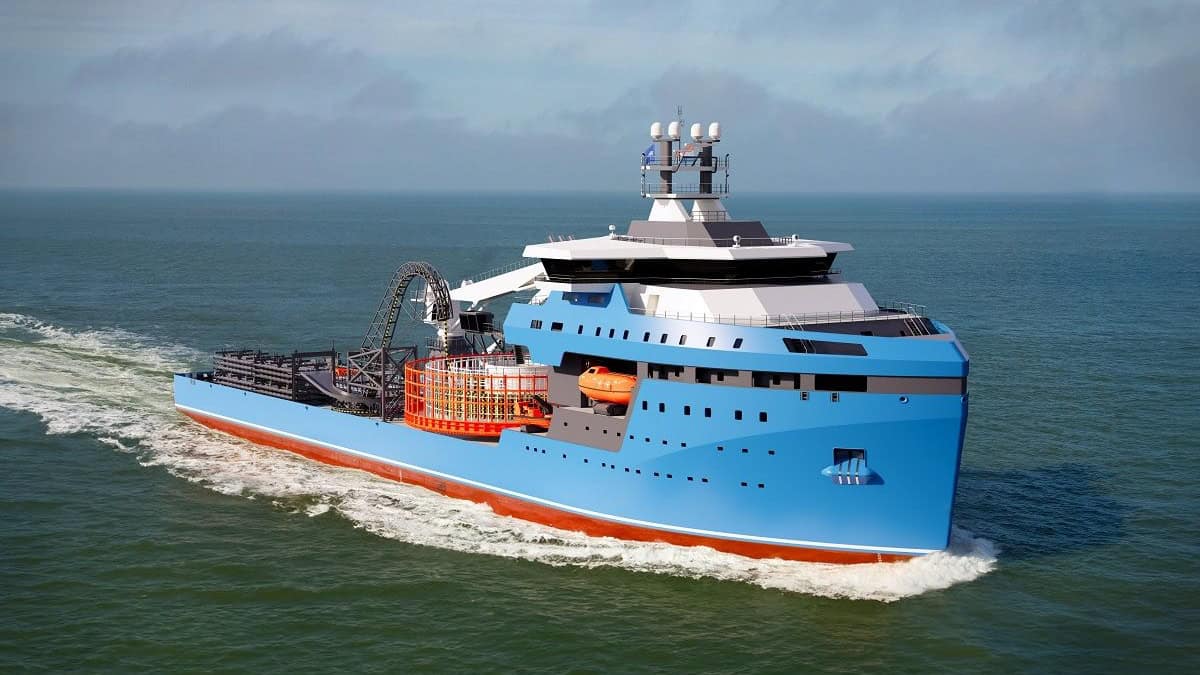
Around ten years ago, the Damen Offshore Carrier (DOC) was launched. The idea was simple – maximum versatility and optimum efficiency. The DOC was employed in cable laying operations, demonstrating a flexible, reliable approach to the task.
Now, Damen has applied the proven credentials of this vessel, combined with the capabilities required by the modern maritime operation to a new, dedicated Cable Laying Vessel (CLV), as Naval Architect specialist Rolf Sluman explains.
“To maintain the relevancy of our designs we continue to develop them based on evolving market needs and emerging technologies. With the cable laying vesselour aim has been to provide the client with a proven, reliable vessel suited to current operational requirements, with shorter lead times and increased cost-efficiency.”
One way in which Damen has achieved this is with the application of a theme for which the company has become renowned – standardisation. At least to a degree.
“With a vessel such as this, it’s challenging to create a standard platform in the way we would with, for example, a tug, crew transfer vessel, or other workboats. One of the key themes of the cable laying vessel is its versatility. This requires a certain amount of customisation for each vessel. What we can do, however, is apply standard principles and components in order to able to adapt quickly to client requests.”
In order to achieve this, Damen is working on establishing the design parameters – weight, stability, speed-power etc. – that will enable it to perform engineering and produce required documentation. This will also enable the company to give a price indication at a much earlier stage in the process.
With a proven design both below the main deck, encompassing the power generation and propulsion layout, and above in the superstructure, including HVAC, crew flow, accommodation, and bridge layout, the vessel’s foundation is solid. This leaves the client-specific area arrangement open for modifications.
“It’s a modular approach leaving the middle of the vessel free for the installation of whatever mission-specific equipment the client requires,” says Rolf.
The vessel displays an impressively flexible scope. The cable laying vessel can be constructed to host the equipment necessary for installation, maintenance and repair of inter-array and export cable spreads.
In order to meet Damen standards and modern operational needs, the next generation CLV is required to display an increased level of environmental awareness.
“Our clients are increasingly demanding sustainability. Damen has responded to this by setting ourselves the goal to become the most sustainable maritime solutions provider,” explains Rolf. “One of the ways we go about this in the design of our vessels. In the majority of cases, the technology has not yet reached a stage of maturity. We are, however, building vessels today that will still be operating in 25 years time, so they have to be ready for the transition.”
Damen’s approach to this is to prepare the cable laying vessel for methanol propulsion when the time arrives. The vessel will feature engines suitable for the use of methanol in the future. Similarly, its tanks will be arranged in a manner suited to methanol storage.
“We’re also including cofferdams for hazardous zone partitions and reserving the space for piping and ventilation, etc. to make the future conversion to methanol straightforward,” says Rolf.
In a further move towards sustainable efficiency, the new CLV vessels will feature a battery system for peak shaving, DP spinning reserve and electrical sailing for short periods. This means that the installed power of the generator sets can be reduced, thereby lowering emissions.
The superstructure, funnels and lifeboats on the new vessels have been designed to be much more compact than previously, freeing up additional space on main deck for mission equipment. The vessel will also feature construction optimisation resulting in significantly lower weight, enabling extra payload. The tank layout, including the double bottom height, has been optimised to offer additional stability, which also enables the carrying of extra cargo.
A further improvement to the onboard experience results from the optimised ballast water arrangement, with large roll reduction tanks installed at a high level. This arrangement offers considerably improved seakeeping.
The new concept offers the chance to take safety and reliability to another level with dynamic positioning, too. The CLV was prepared for DP2 installation. The new CLVs, however, will go a step further, with space reservation for DP3.
Damen envisages a range of three vessels – the CLV 4000-6500 Hybrid, the CLV 6000-10000 Hybrid and the CLV 9000-13000 Hybrid. The vessels will span cable payload between 4,000 and 13,000 tons and will be between 90 and 145 metres in length, to suit a range of operational requirements.
Rolf concludes, “The CLV represents a step forward – in terms of safety, sustainability, comfort and efficiency. It really is a design fit for the future. I’m looking forward to the first client enquiry and getting this vessel off the drawing board and into the water.”
In order to meet Damen standards and modern operational needs, the next generation CLV is required to display an increased level of environmental awareness.
“Our clients are increasingly demanding sustainability. Damen has responded to this by setting ourselves the goal to become the most sustainable maritime solutions provider,” explains Rolf. “One of the ways we go about this in the design of our vessels. In the majority of cases, the technology has not yet reached a stage of maturity. We are, however, building vessels today that will still be operating in 25 years time, so they have to be ready for the transition.”
Damen’s approach to this is to prepare the CLV for methanol propulsion when the time arrives. The vessel will feature engines suitable for the use of methanol in the future. Similarly, its tanks will be arranged in a manner suited to methanol storage.
“We’re also including cofferdams for hazardous zone partitions and reserving the space for piping and ventilation, etc. to make the future conversion to methanol straightforward,” says Rolf.
In a further move towards sustainable efficiency, the new CLV vessels will feature a battery system for peak shaving, DP spinning reserve and electrical sailing for short periods. This means that the installed power of the generator sets can be reduced, thereby lowering emissions.