


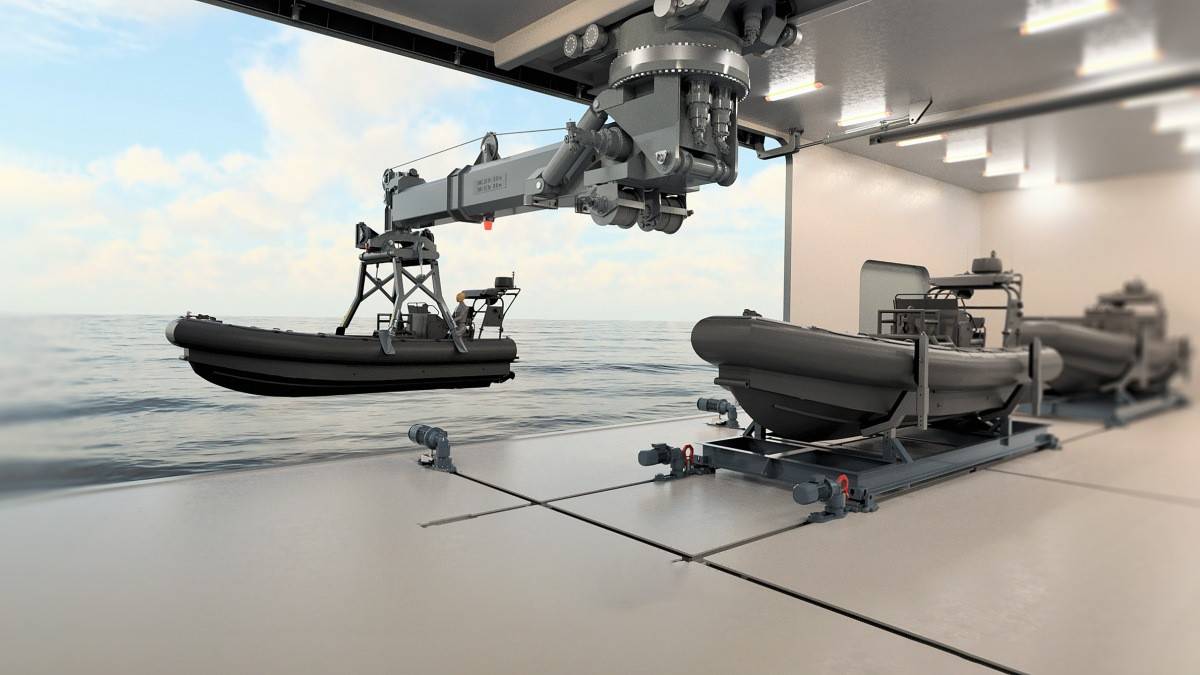
With over 80 years of experience in providing cutting-edge solutions to the naval market, Kongsberg Maritime is setting a new standard in naval mission-sensitive versatility with its new Mission Bay Handling System.
The next-generation of surface combatants are poised to carry a diverse array of manned and unmanned off-board vehicles and modular mission packages. To meet these evolving demands, the Mission Bay Handling System has been designed to offer an adaptable and flexible integration solution suitable for a wide range of naval operations, both current and future.
The Mission Bay Handling System is a game-changer for naval forces worldwide, as it enables the efficient deployment and recovery of both manned and unmanned crafts, with a vast range of hull types and propulsion configurations, from both sides of the ship. In today’s rapidly changing battlespace, naval forces demand flexibility and multi-purpose ships. Thus, Kongsberg Maritime’s Mission Bay Handling System is one key to transforming naval capability.
Robert Breivik, Kongsberg’s Senior Sales Manager – Naval, emphasised the significance of modularity in naval operations, stating, “I speak to a lot of navies, and the one thing they all want is modularity. Navies want platforms that can easily be transformed to meet mission requirements, so the days of ships that are dedicated to a small range of tasks are over.”
The global security landscape is evolving more rapidly than ever before, with urgent requirements in areas like underwater surveillance and monitoring of seabed utility assets like pipelines and cables. Modern ships must be multi-role, which means carrying a growing suite of newer, high-tech in-sea assets. The Mission Bay Handling System is designed to swiftly, safely, and effectively transport these assets, and where relevant their crews, to and from the hangar aboard the ship.
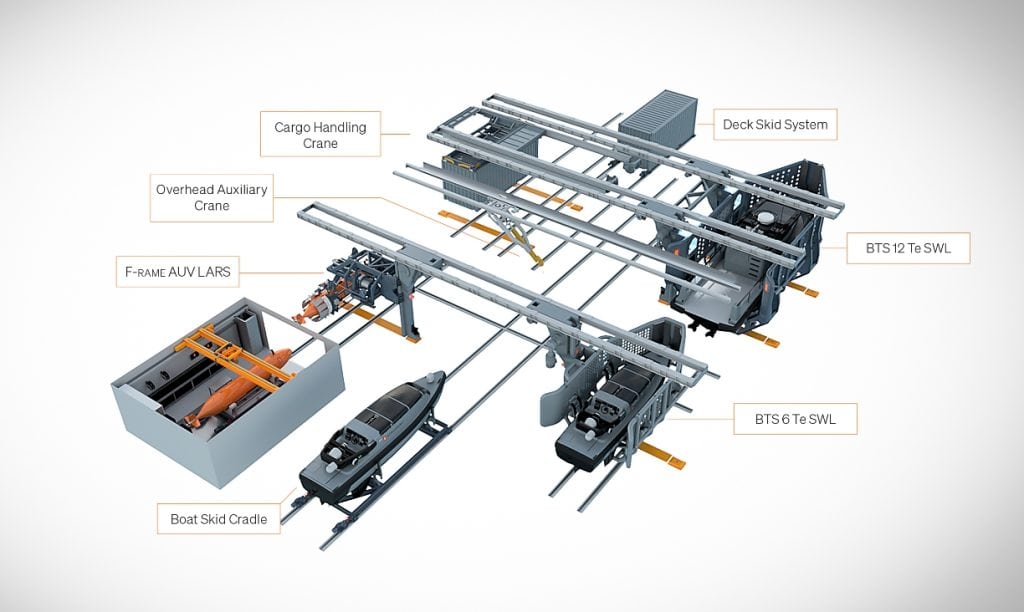
The system is suitable for a wide range of naval ships and is widely scalable to fit the size of the mission bay. It consists of three key elements:
Overhead Frame System: Using a standardised interface with the ship, this comprises rails and an ‘interface unit’ that connects to a wide range of interchangeable tools, enabling quick tool changes without altering the core of the handling system. It offers both single and dual rail systems, with capacities up to 12 tonnes.
The Frame System is fixed to the deck above the mission bay, allowing in-sea assets to be suspended and easily moved from their storage spaces.
Multi-Purpose Hangar Crane: Handles 10’ and 20’ ISO containers up to 15 tonnes, rotating through 360 degrees and extending to the water level. This crane excels in the rapid deployment and retrieval of daughter craft up to 10 tonnes.
“Through our extensive experience from a lot of similar systems we have developed for subsea, oceanographic and research ships, this crane is not only very capable, but it gives navies options. It can handle cargo in standard shipping containers, and switch to deploying subsea and surface craft, quickly and safely,” adds Breivik.
Additionally, various Auxiliary Equipment is available to complement the two main handling systems: a Deck Skid System, containerised launch and recovery systems, cargo handling crane for containers, and an overhead auxiliary crane for lighter loads.
Key Benefits of the Mission Bay Handling System:
- Clean Deck: No permanent tripping hazards or obstacles installed on the deck.
- Modularity: Built from an interchangeable suite of flexible handling systems.
- Adaptive: Designed to fit hangars with different dimensions and shapes.
- Time and cost saving: Eases mobilization and demobilisation, eliminating costly rebuilds between each mission setup.
Kongsberg Maritime’s Mission Bay Handling System represents a major step forward in mission capabilities. It offers unmatched adaptability, efficiency, and safety, ensuring that naval forces are prepared to meet the challenges of the modern maritime battlespace.