



Pascal Technologies will supply the electric powertrain platform for the Hyke F-15 Shuttle ordered by Cityboat for operations in Norway.
Hyke has partnered with Pascal Technologies to develop the electric powertrain platform for the Hyke F-15 Shuttle, the zero-emission passenger vessel ordered by Cityboat for operations in Norway.
Under the agreement, Hyke will deliver the vessel with the lightweight composite hull constructed by Herde Kompositt, while Pascal Technologies will provide the vessel’s electric propulsion and powertrain architecture.
Pascal Technologies has now joined the platform as the powertrain partner, with the explicit ambition of pushing those numbers further: higher efficiency across the duty cycle, lower drivetrain weight, and a software architecture giving the operator real-time insight and control on the water.
“Hyke has built an extraordinary vessel. Our job is to make it a little better where it counts most: on the water, every single day. Every kilo and every kilowatt-hour matters, the powertrain platform decides how far, and how economically the boat actually runs.” Carl Rehn, CEO, Pascal Technologies
“We’ve spent years building a vessel that doesn’t compromise on energy use or passenger experience. Pairing the F-15 Shuttle with Pascal’s powertrain platform is a natural next step. They share our view that this segment needs purpose-built technology, not adapted leftovers from larger vessels.” Halvor Vislie, CEO, Hyke
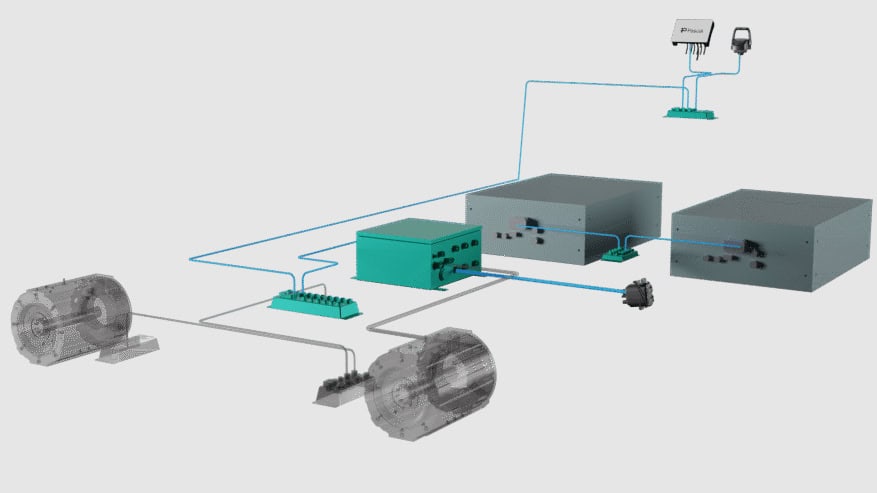
Pascal’s powertrain platform is built around a modular, standardized architecture. It is delivered as a kit of interchangeable modules. Cabling arrives prefabricated and pre-terminated, so general yards can install it without specialist electrical expertise. That raises build quality, lowers cost, and shortens commissioning. The same modularity keeps the system tight onboard. Power distribution and communication take up minimum space, freeing up area for passengers. It also makes the vessel easier to service over its lifetime, since individual units can be swapped without redesigning the surrounding system.
Cooling, charging, propulsion, ventilation, pumps and lighting are tied together as a single distributed and integrated system. The operator works from one unified user interface with real-time visibility across every subsystem. The interface is designed to be simple enough that the vessel can be operated by different crews without extra training. Pascal owns the entire control stack, so the system can be diagnosed and troubleshot down to component level.
“Small electric vessels can’t just inherit big-ship engineering. The loads, the operating profile, and the charging reality are different in kind. To get to real scale we have to think from first principles: lightweight components, deep system integration, software as the backbone, and an architecture built to be produced in series, not as one-off projects.” Per Sondre Sodeland, CTO, Pascal Technologies.
For Cityboat, the result is a powertrain developed specifically for this kind of operation: light composite vessel, high daily utilisation, frequent fast charging, and serviceability built around a standard product.
The Hyke F-15 Shuttle carries up to 50 passengers, has 196 kWh of installed battery capacity, and supports 150 kW DC and 22 kW AC charging. The combined Hyke and Pascal solution is built for sustained daily operation and for replication in other cities. By relying on existing waterways, operators can open new transport links with minimal physical intervention and far lower capital requirements than land-based alternatives.
Cityboat is a joint venture between express boat operator Rødne and local tourism company Viking Adventure.














