



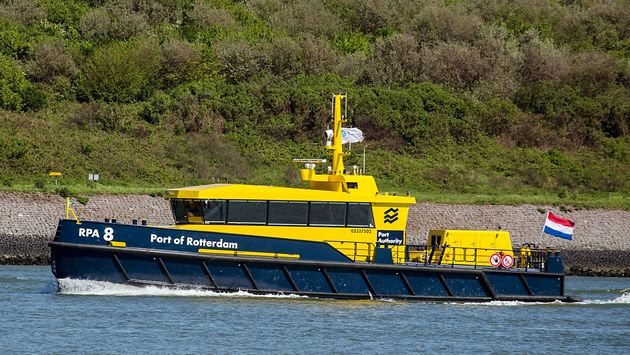
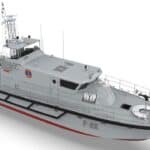
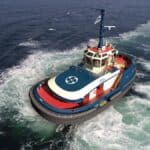
The Port of Rotterdam Authority is going to accelerate the reduction of its own carbon emissions. Today, most of the CO2 of the Port Authority is emitted by the (patrol) vessels. CO2 is also emitted by the use of cars and buildings. It concerns 4,000 tonnes per year in total.
The Port Authority’s own carbon emissions should be 75% lower in 2025 and 90% lower in 2030 than in 2019. Eventually, the Port Authority wants its operations to be entirely emission-free. “We are going to reduce our own carbon emissions as quickly as possible, while compensating in full what we still emit. So from that perspective, the Port Authority is already carbon neutral as we speak. Because our emissions will be lower and lower in the next few years, the compensation required will also decrease more and more,” says Allard Castelein, CEO Port of Rotterdam Authority.
In the past year, the Port Authority used so-called science-based targeting to calculate the emission reduction amount required to pull its weight to keep global warming below the 1.5 degrees celcius limit. Science-based targeting is a way of translating the Paris Climate Agreement per company into specific targets. With this method, the Port Authority should achieve a reduction of at least 46.2% by 2030 (in comparison with 2019). As this seems to be technically feasible, however, the Port Authority opts for accelerated reduction of its own emissions by 90% in 2030. To this end, the Port Authority will ensure that all its vessels will switch completely to biofuel in the short term, and it has the ambition that from 2025 new vessels will be emission-free.
The Port Authority also wants to realise lower carbon emissions in other areas. Emission caused by its employees’ air travel is to be reduced by 70% in 2025 and by 80% in 2030, as a result of flying less and participation in a biokerosene programme. Reduction objectives have been formulated for assignments awarded to contractors of the Port Authority as well. In this case, it is about a 45% reduction by 2030 with the use of fuels (especially dredging and earthmoving) and 20% for (construction) materials. Huge amounts of steel are used in the construction of quay walls, for example. Since its production provisionally involves high carbon emissions, 20% in 2030 seems to be the maximum feasible level.
Reasons for tightening the climate targets include the recent climate studies of the Intergovernmental Panel on Climate Change, the ‘Fit for 55’ plans of the European Commission, and the Glasgow Climate Summit at which the target of a maximum temperature increase of 1.5 degrees celcius was confirmed.
Industry and shipping
The Port Authority also does its utmost for emission reduction in shipping and industry, although it cannot influence this directly. This approach is based on two studies by the German Wuppertal Institut from 2017 and 2018 respectively into the emissions of industry and shipping and the transition paths for both sectors.
For shipping in the port management area (which reaches as far as 60km off the coast) the emissions should be reduced by 20% in 2030. To make this happen, various developments are in progress, like efficiency increase (by optimising logistics processes), the application of shore power (so that berthed ships can switch off their generators and plug in), and bunkering clean fuels (such as LNG, biofuels, and methanol) by shipping.
This should be made possible by projects on capturing CO2 and storing it beneath the North Sea bed (Porthos), construction of pipes for hydrogen and residual heat, and attracting innovative developments, such as the production of green hydrogen and biofuels. All these projects together amount to some 23 million tonnes of carbon reduction in the port and outside (by the use of biofuels produced there, for example). This is 35% of the Dutch carbon reduction objective for 2030.








 vessels. CO2 is also emitted by the use of cars and buildings. It concerns 4,000 tonnes per year in total.RPA8The Port Authority’s own carbon emissions should be 75% lower in 2025 and 90% lower in 2030 than in 2019. Eventually, the Port Authority wants its operations to be entirely emission-free. “We are going to reduce our own carbon emissions as quickly as possible, while compensating in full what we still emit. So from that perspective, the Port Authority is already carbon neutral as we speak. Because our emissions will be lower and lower in the next few years, the compensation required will also decrease more and more,” says Allard Castelein, CEO Port of Rotterdam Authority.)