



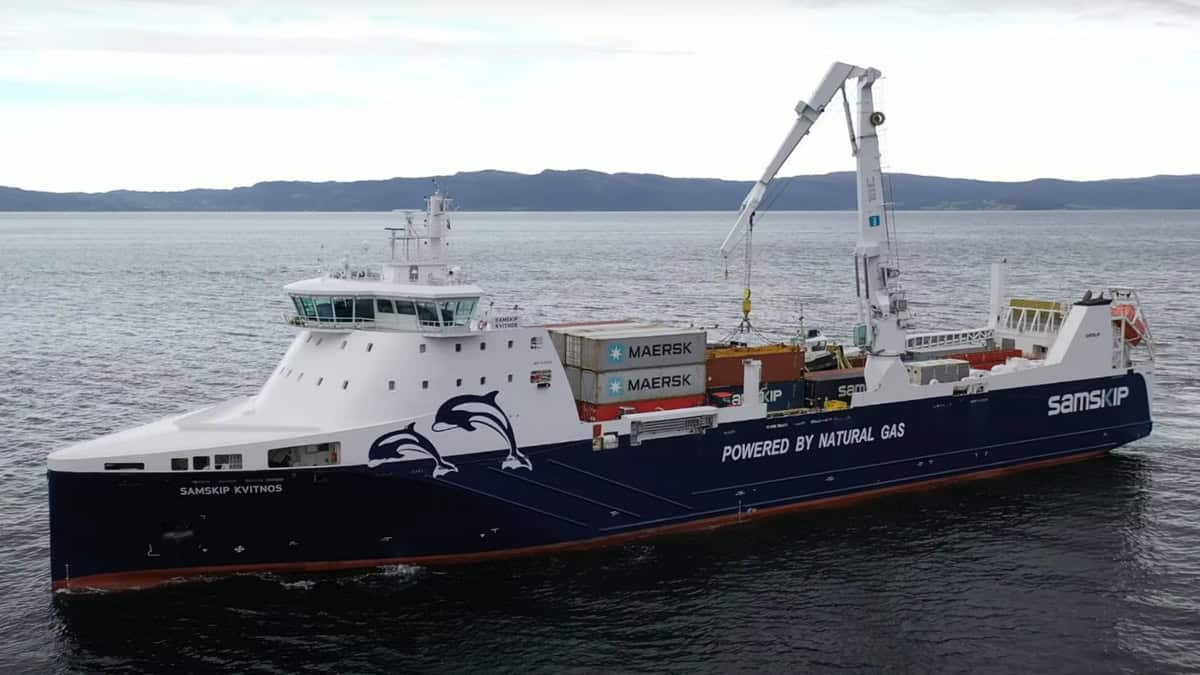
TECO 2030 and the HyEkoTank consortium announce that Samskip has been formally approved by the EU as partner in the HyEkoTank project. The consortium also announces that the vessel to be retrofitted with their zero-emission technology will be Samskip’s MPP vessel Kvitnos.
Samskip Kvitnos, built in 2015, is a cargo ship which operates in a fixed route on a weekly multipurpose service from Rotterdam, along the Norwegian west coast, all the way north to Hammerfest.
The HyEkoTank project is the world’s largest ongoing fuel cell retrofit project, aiming to demonstrate zero-emission fuel cell and hydrogen technology contributing to decarbonization of the worlds existing fleet of more than 100,000 ships. By introducing zero-emission hydrogen technology, the project partners have set a clear goal of reducing greenhouse gas emissions.
Samskip itself already has strict decarbonization targets and goals set and hopes that this collaborative effort will be a great addition towards staying on schedule with their targets.
Samskip, as a container ship operator, is facing increasingly stricter requirements to reduce greenhouse gas emissions through regulations such as FuelEU Maritime and EU Emissions Trading System (EU ETS). Container ships are also required to operate with zero emissions at major EU ports from 2030, and will be subject to zero emissions requirements when sailing in Norwegian world heritage fjords.
Fuel cells and hydrogen provides the most energy-efficient and cost-efficient fuel solution for the Kvitnos vessel, because Kvitnos consumes much more energy than can be charged by shore-power, and hydrogen is the most energy-efficient and least expensive zero-emission fuel. With support from HyEkoTank, this vessel will be retrofitted in 2025 with fuel cells from TECO 2030 and hydrogen storage from Umoe Advanced Composites. This retrofit aims to make Kvitnos compliant to FuelEU Maritime and EU ETS regulations for the remainder of its expected lifetime.
“I am excited to announce the HyEkoTank partnership with Samskip. Almost all of the 2-3000 new built ships each year are built with conventional fossil technologies, and the average ship lifetime is 25-30 years. To achieve the maritime sector GHG reduction targets retrofitting zero-emission technology on the existing fleet is essential. That is why the EkoTank project is so important”, says HyEkoTank’s project coordinator Leif-Gunnar Hanssen.
“I am thrilled to partner with Samskip in their mission to achieve net zero by 2040. The synergy between our fuel cell technology and Samskip’s commitment to operational sustainability creates the ideal foundation for future-proofing their existing fleet for long-term success in the maritime industry,” says TECO 2030’s Group CEO Tore Enger.
Samskip highly appreciates to collaborate with TECO 2030 and all the other professionals of the HyEkoTank project, with the support of a grant from the European Union’s Horizon program.
Using the power take in device (PTI) driving the propellor with green energy, allows existing vessels to sail and maneuver emission-free in European coastal areas and Norwegian Fjords’ says Erik Hofmeester, Head of Vessel Management for Samskip.
The HyEkoTank project has received funding from the European Union’s Horizon Europe Innovation Actions programme under grant agreement No. 101096981. The project partners are TECO 2030, BLOM Maritime, TECO Solutions, Shell International Trading and Shipping Company, Shell International Exploration and Production, Samskip, Nav-Tech, Umoe Advanced Composites, FKAB Marine Design, Tarbit Shipping and project coordinator UiT The Arctic University of Norway.














