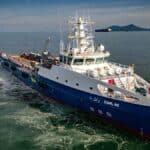



Sea Machines Robotics, the leading developer of autonomous command and control systems for the maritime industry, announced today that it has completed the world’s first 1,000+ nautical miles autonomous and remotely commanded journey of a commercial vessel at sea. Under the project name The Machine Odyssey, the autonomous tug Nellie Bly completed its journey in just 129 operational hours over 13 days. The program was commanded by U.S. Coast Guard-licensed mariners remotely stationed 3,000 miles away in Boston, many of whom are also members of the American Maritime Officers union.
The Sea Machines celebrates the final arrival of Nellie Bly in Hamburg, after more than 1,000 NM autonomously navigated.
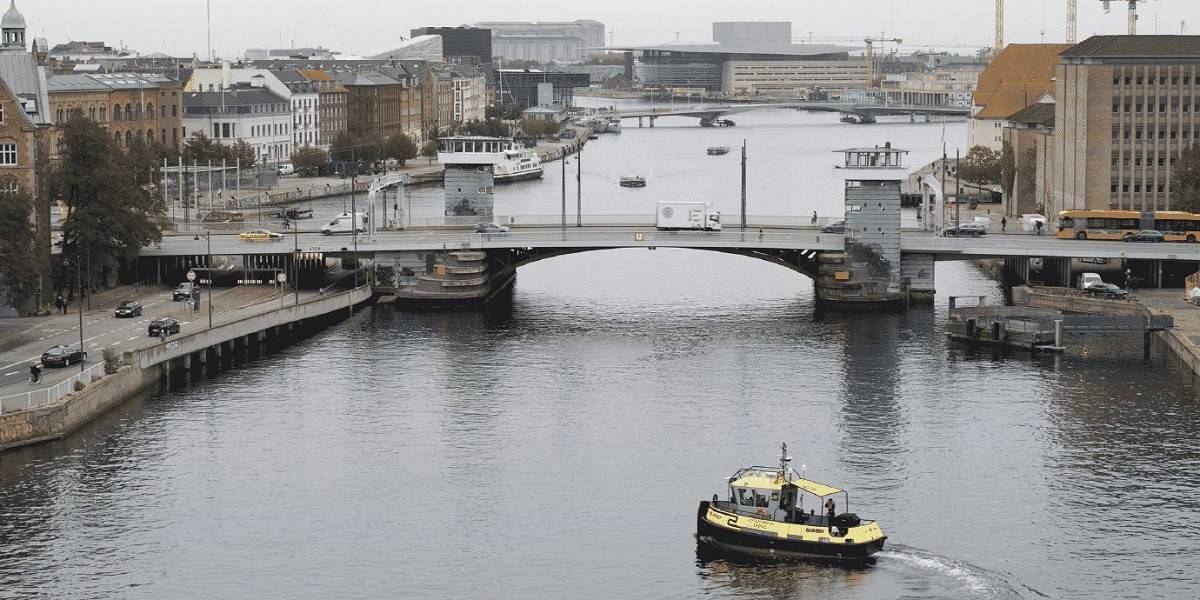
“The completion of this voyage marks the catalyst for a new era of at-sea operations,” said Michael Johnson, CEO of Sea Machines. “Over the last two millennia it’s estimated that around one-hundred million vessels have transited these same Danish waters. Though vessels, cargos, nations and destinations have changed, the way these great ships are commanded has remained virtually constant, with humans onboard making navigational decisions, undertaking manual control actuation, and communicating person to person. Only now are we revealing a new method of operation. Remotely commanded autonomous vessels provide the marine industries with the platform necessary to be competitive in the modern world, delivering significant increases in productivity and operational safety, digitized ultra-efficiency and response speed, and will provide a new world of actionable operational data for improved planning and business practices. The Machine Odyssey signals the start of a new human-technology relationship propelling on-sea operations in the 21st century.”
View from the helm: The autonomous Nellie Bly at sea
The Nellie Bly employed first-of-it’s-kind AI-enabled, long-range computer vision and a sensor-to-propeller autonomy system, the Sea Machines SM300. Its technical features allowed for path-planning, active domain perception, dynamic obstacle, and traffic avoidance and replanning, depth sensing, and fusion of vectored nautical chart data. 96.9% of the 1,027 mile journey was accomplished under fully autonomous control and the SM300 successfully executed 31 collision-avoidance and traffic separation maneuvers.
Using multi-sensor fusion, the system digitally perceived over 12,000 square miles of ocean space more accurately and comprehensively than comparable human operators. This successful autonomous operation demonstrates that with this technology the world’s fleets can ply the oceans in a more predictable and safer manner, while optimizing the global supply chain by delivering a greatly more efficient and productive means of transportation than what exists today.
A team of USCG-licensed mariners remotely commanded the Nellie Bly in Denmark from a control station located in Boston.
Throughout the voyage, the tug averaged a speed of 7.9 knots. Sea Machines garnered 3.8TB of essential operational data showcasing how the ships can readily connect as IOT systems into the cloud economy. The SM300 also provided the remote commanders in Boston with an active chart of the environment and live augmented overlays showing the progress of the mission, state of the vessel, situational awareness of the domain, real-time vessel-borne audio, and video from many streaming cameras.
“Autonomy is taking hold faster on the waterways than it is on roadways,” continued Johnson. “Our autonomous systems are already supporting vessel operations around the world in manned and unmanned capacities. We are rapidly retooling the marine industries with an advanced perception, self-piloting system, and connected vessel intelligence. The Machine Odyssey was a success and we believe we will soon see autonomy become commonplace.”
About Sea Machines
Headquartered in the robotics and deep-technology hub of Boston and operating globally, Sea Machines is the leader in pioneering autonomous command and control and advanced perception systems for the marine industries. Founded in 2015, the company builds autonomous vessel software and systems, which increases the safety, efficiency, and performance of ships, workboats, and commercial passenger vessels. Learn more about Sea Machines at www.sea-machines.com.