




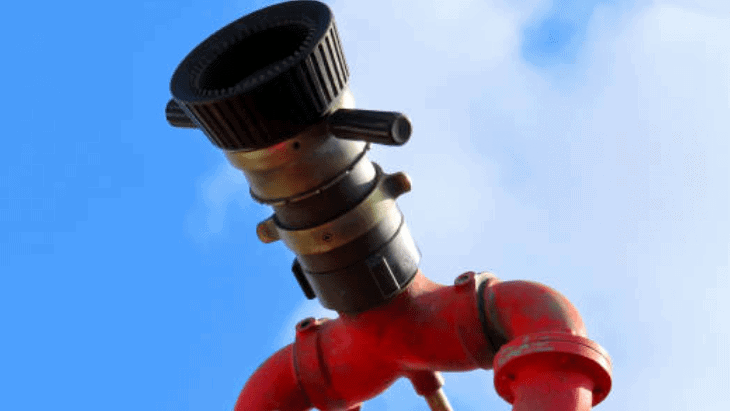
A new IMO resolution will see the phase-out of foam firefighting systems that use fluorinated foams containing perfluoro-octane sulfonic acid (PFOS) as the foam-producing component. The new rules come into effect under a rolling programme beginning in 2026, but Swedish maritime engineering specialist Scanunit believes that a proactive replacement strategy should be put into effect now.
Foam firefighting systems on ships typically make use of a family of synthetic chemical compounds known as perfluoroalkyl and polyfluoroalkyl substances (PFAS). They are used in a variety of applications aside from firefighting because of their very useful properties but their use is now being questioned as they have been shown to be toxic, bio-accumulative, and very persistent substances in the environment.
The common PFAS-compound in foam systems is perfluoro-octane sulfonic acid (PFOS), although other PFASs may also be used. PFOS has been restricted in most Western countries since 2009 under the Stockholm Convention because of its impact on human health. These restrictions have led to an industrial transition and replacement of PFOS, although some of the replacements are other PFASs that may also be considered hazardous after more study.
Following work by the SSE sub-committee at the IMO, the MSC adopted resolutions MSC.530(107) amending SOLAS Chapter II-2 and resolutions MSC.534(107) & MSC.535(107) amending the HSC Codes (1994 and 2000) to prohibit the use of firefighting foams containing PFOS. This ban applies to both fixed and portable systems and comes into effect for new ships on 1 January 2026. Systems on existing ships will need to remove the PFOS and dispose of them safely ashore no later than the first survey date on or after January 1, 2026.
The IMO is also looking at extending the ban to other fluorinated substances, in addition to PFOS, and for this reason, the changes to SOLAS and the HSC Codes have been done by the addition of a new section, “Fire Extinguishing Media Restrictions”, in each text making it easier to include future prohibitions or limitations of extinguishing media.
“Shipowners need to understand the implications of the rule changes for existing ships and to consider how best to comply with the impending and future rules as there are some pitfalls to avoid”, says Mikael Laszlo, Sales Director, Scanunit.
It should be noted that shore systems in most countries have already transitioned to new chemicals. The requirements of regulatory bodies such as the ECHA in Europe and the EPA in the US suggest that PFAS in fire-fighting foam and equipment be limited to 1 ppm (in the foam). Shipping is likely to follow along this path so with the possibility of a future ban on other fluorinated substances by the IMO, the choice of replacement needs to be carefully considered from the outset.
It may not be immediately apparent as to whether the foam contains PFOS or PFAS. There should be some mention in the foam certificate or product safety data sheets, but this is not always the case. It is, therefore, important to analyze the particular foaming agent currently in use to ascertain its composition.
The IMO guidelines for testing detailed in MSC.1/Circ.1312 may have comprehensive instructions for testing the operational aspect of firefighting foam concentrates but do not contain any mention of their chemical composition. Similarly, the type-approval certificates for foam concentrates supplied by classification societies and testing laboratories are equally unenlightening.
Another point to consider is that manufacturers are already switching to alternative products and there is always a possibility that supplies of foaming agents will dry up before the IMO ban comes into effect. If that happens ships will be required to make an immediate change in any case and perhaps have trading opportunities restricted until this is done.
For existing ships affected by the IMO rules, replacing the foaming agent is not simply a matter of emptying the tank and exchanging the agent with one that does not contain PFOS. To ensure that no restricted substances are released during testing or deployment the whole system will need to be decontaminated.
Scanunit, in partnership with compatriot Swedish company LifeClean, is offering a turnkey solution for decontaminating and replacing the foam onboard vessels. The process need not be done in drydock and can be arranged to suit the vessel’s schedule.
The process involves removing the old foam and then refilling the whole system with Sani A, a cleaning fluid developed by LifeClean, that remains in the system for around four hours. The system is then emptied and the process repeated. A sample is then taken from the hoses and tested to ensure that the level of PFOS is at or below 1 ppm. Ragnar Krefting, Founder, Lifeclean explains that the process is perfectly safe and produces less wastewater than other methods. Importantly, independent tests have shown that 99.97% of all PFAS substances in the tanks and foam system have been removed.
Occasionally, a system may need to be upgraded for use with the replacement fluorine-free foam or perhaps because the owner considers this desirable. Scanunit can handle all the arrangements and documentation necessary to do this.
In such cases, it only needs the vessel to provide a copy of the current system manual and it will then design and source any necessary new components. This is done in conjunction with the ship’s classification society to ensure that necessary approvals are granted. After obtaining approval, installation is arranged at a convenient place and date with Scanunit supplying materials and personnel to carry out the fitting.
“We have the experience and ability to help owners meet all their obligations under the new IMO rules and we would urge them to go the extra mile and meet the ECHA/EPA standards now rather than wait or carry on with a time-compromised system, says Mikael Laszlo, Sales Director, Scanunit.













 as the foam-producing component. The new rules come into effect under a rolling programme beginning in 2026, but Swedish maritime engineering specialist Scanunit believes that a proactive replacement strategy should be put into effect now.)