Ship & Boat BuildingBreakbulk & Heavy Lift VesselDajin Launches Second Deck Carrier KING TWO

Dajin Launches Second Deck Carrier KING TWO

Dajin Shipping’s Sister vessel to KING ONE enters market as demand for XXL monopile transport accelerates

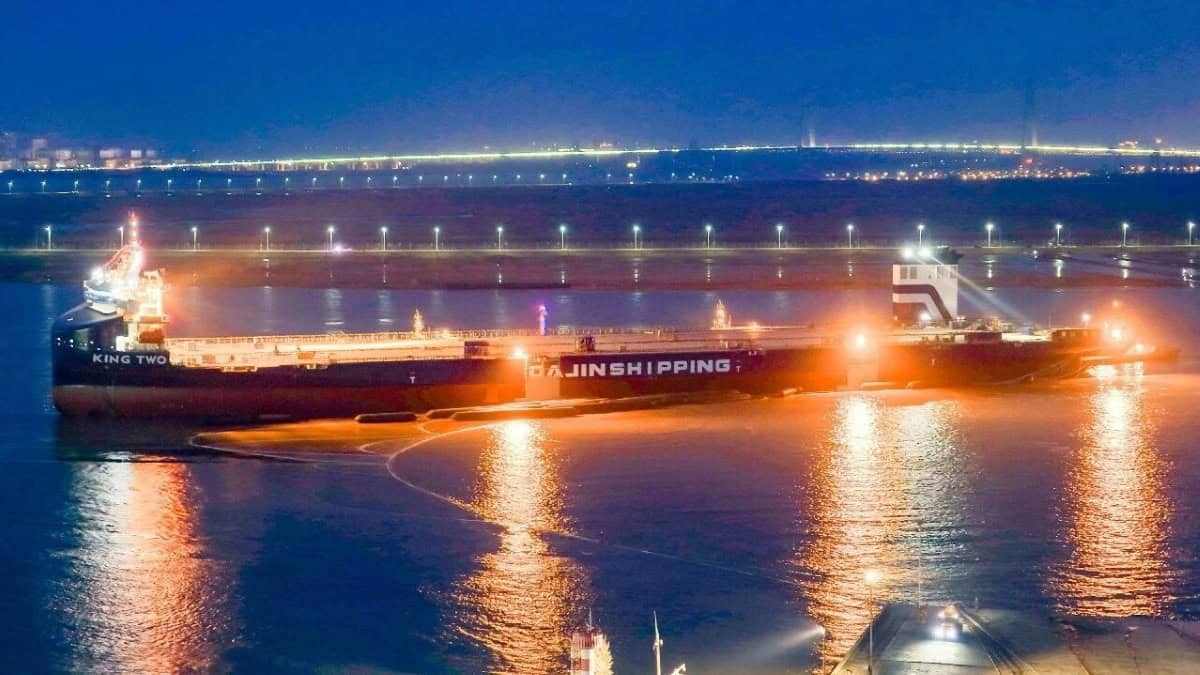
Dajin Shipping has launched the 40,000 dwt deck carrier KING TWO at its Dajin Panjin shipbuilding facility, marking the second large-scale deck carrier to be delivered by the yard. The vessel follows its sister ship, KING ONE, which has already completed its maiden voyage.

The launch reinforces Dajin’s growing capability in the construction of heavy-lift vessels tailored for the offshore wind sector, where demand for high-capacity transport solutions continues to accelerate.

KING ONE recently demonstrated these capabilities during its first deployment, transporting eight XXL monopiles—each approximately 10 metres in diameter and weighing in excess of 1,200 tonnes—for the Hornsea 3 Offshore Wind Farm. The project, located off the UK coast, is set to become one of the largest offshore wind farms globally upon completion.

The successful execution of this voyage highlights the increasing scale of offshore wind components and the corresponding need for specialised vessels capable of safely and efficiently transporting next-generation foundations.

With the addition of KING TWO, Dajin continues to expand its portfolio of advanced deck carriers, supporting the global offshore wind industry’s push toward larger installations and more complex logistics.

Following the launch of KING TWO, a third vessel in the KING series is scheduled for launch in May 2026, with both newbuilds expected to enter service later this year, further expanding capacity in the heavy-lift offshore transport segment.

Key Specifications:

  • Length: 239.8m | Breadth: 51m | Depth: 13m
  • Deck Area: 12,000 m²
  • Deadweight: 40,000 tons
  • Design Features: Dual engines with dual propellers
  • Performance: Speed of 13 knots | Range of 16,000 nautical miles

Latest News

The International Institute of Marine Surveying (IIMS), working in collaboration with the International Marine Contractors Association (IMCA) and the Workboat Association, has announced the publication of the International Workboat Code of Practice, a 122-page guide providing best-practice guidance for the construction, operation and surveying of commercial workboats.

IIMS, IMCA and Workboat Association Launch International Workboat Code of Practice

IIMS, IMCA and the Workboat Association collaborate on a 122-page guide covering vessel safety, operational standards and crew competency for commercial workboats worldwide The International...
The world’s largest battery-electric ship has officially entered commercial passenger service, marking a major milestone for maritime electrification and zero-emission vessel operations. Built by Incat Tasmania for long-standing customer Buquebus, the 130-metre China Zorrilla has completed its maiden commercial voyage between Buenos Aires, Argentina, and Colonia, Uruguay, across the River Plate.

China Zorrilla Begins Electric Ferry Operations

Built for Buquebus to connect Argentina and Uruguay, the China Zorrilla, the world’s largest battery-electric ferry, marks a major milestone in large-scale marine electrification...
Boluda Towage has expanded its Norwegian fleet with the addition of VB NORWEGIAN FALCON, a new tug built by Sanmar Shipyards to support towing, vessel assistance and offshore operations in demanding maritime environments.

Boluda Towage Takes Delivery of VB NORWEGIAN FALCON

Sanmar-built VB NORWEGIAN FALCON features RAstar 3200 SX design, ASD propulsion and more than 6,700 hp Boluda Towage has expanded its Norwegian fleet with the...
SWITCH Maritime has secured a Design Basis Agreement (DBA) from the United States Coast Guard (USCG) for its SWITCH-150 hydrogen fuel cell-electric ferry, marking a key milestone in the development of the 150-passenger vessel. Designed by naval architecture firm Incat Crowther, the SWITCH-150 combines hydrogen fuel cell-electric propulsion with onboard hydrogen storage to support high-frequency ferry operations without compromising service schedules or requiring shoreside charging infrastructure.

SWITCH Hydrogen Ferry Clears Key US Coast Guard Milestone

The US Coast Guard agreement establishes a regulatory framework to guide construction, commissioning and future commercial operation of the hydrogen-powered ferry SWITCH Maritime has secured...

Related news