


Damen Folla and Zeabuz aim to make docking safer while helping aquaculture operators reduce repair and maintenance costs
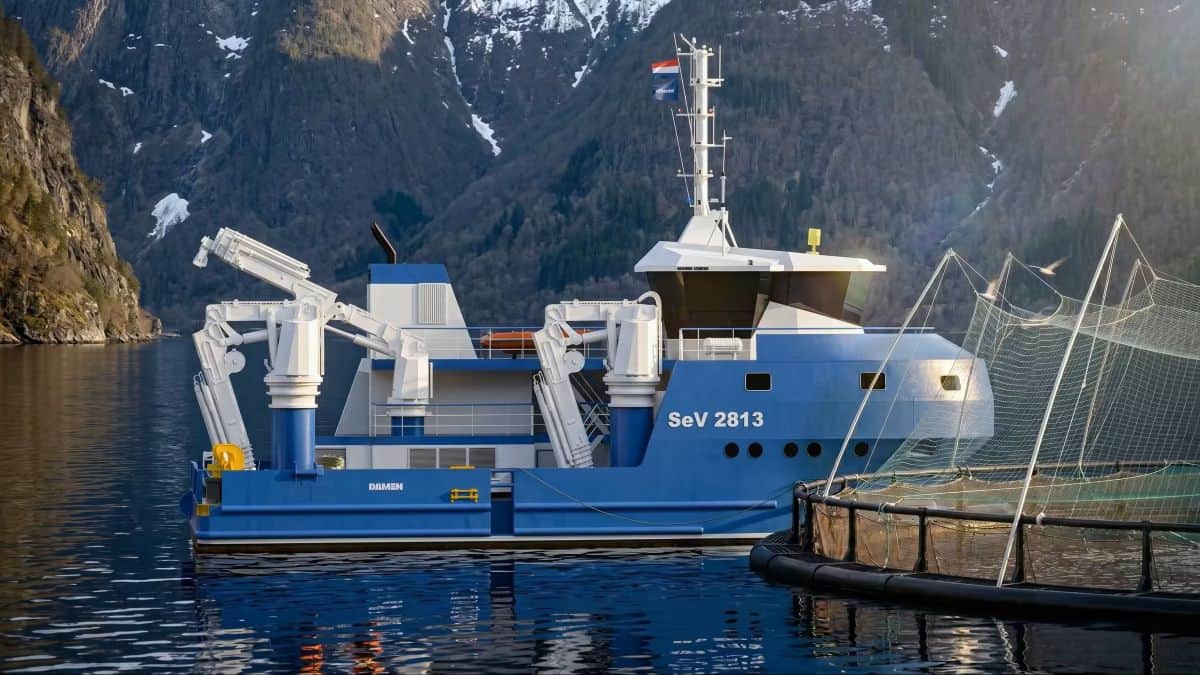
Damen Folla and Zeabuz are unveiling a new smart docking system at Nor-Fishing in Trondheim, designed to help aquaculture operators manoeuvre more safely around infrastructure and other objects in the water. The ZeaWatch Docking Assist system combines a range of technologies to provide crews with a comprehensive overview of their surroundings, including infrastructure and objects both above and below the waterline.
The product is being developed in collaboration with Damen Folla, building on Zeabuz’ recent launch of Docking Assist for ferries. Seeing the potential for the technology in new maritime segments, Zeabuz CEO Øyvind Smogeli and Damen Folla CCO Stig Rune Nørbech began exploring how the same concept could be adapted to the specific challenges of aquaculture workboats.
“Every year, there are many incidents at fish farms with vessels colliding with infrastructure. This often results in significant downtime, with vessels having to go ashore for costly repairs – not to mention the damage caused to the infrastructure,” says Damen Folla CCO Stig Rune Nørbech.
Building on its existing docking-assist technology, Zeabuz began developing a dedicated aquaculture version of the system, adding underwater perception and segment-specific functionality.
“The technologies behind the solution are well proven,” states Stig. “What is unique here is its application. In the automotive industry, and in previous maritime cases, the objective has been to detect objects above or on the waterline. In the aquaculture industry, however, much of the infrastructure lies below the waterline and is, therefore, not visible to vessel operators.”
The solution combines cameras, 4D radar, sonar and GNSS and object detection algorithms to identify infrastructure and build real-time awareness of the vessel’s surroundings, both above and below the waterline. The information is presented in a bird’s-eye view with distance measurements and a traffic-light warning system, helping operators detect nearby objects and monitor their proximity during manoeuvres.
The smart docking system is the latest result of the cooperation between Damen Folla and Zeabuz. Also on display in Trondheim will be the ZeaFalcon – a 7-metre HDPE Damen vessel integrated with a Zeabuz autonomy system.
ZeaFalcon’s autonomy system comprises multiple capabilities, including autonomous navigation, collision avoidance, remote command and control, and autodocking. The vessel will be demonstrating its capabilities in the harbour during the event. Operations will also be livestreamed to a screen in the exhibition hall.
“Automation is only going to grow in importance for the aquaculture industry,” explains Zeabuz CEO Øyvind Smogeli. “Already we are witnessing the effects of crewing challenges. As operations move farther from shore and into more exposed locations, we expect to see increasing use of larger and more complex vessels.”
“Our approach to autonomous technology and navigation support is not aimed at displacing the crew. What we are seeking to do is rather to develop solutions that support the operators, making their work safer, more efficient and more productive.”