


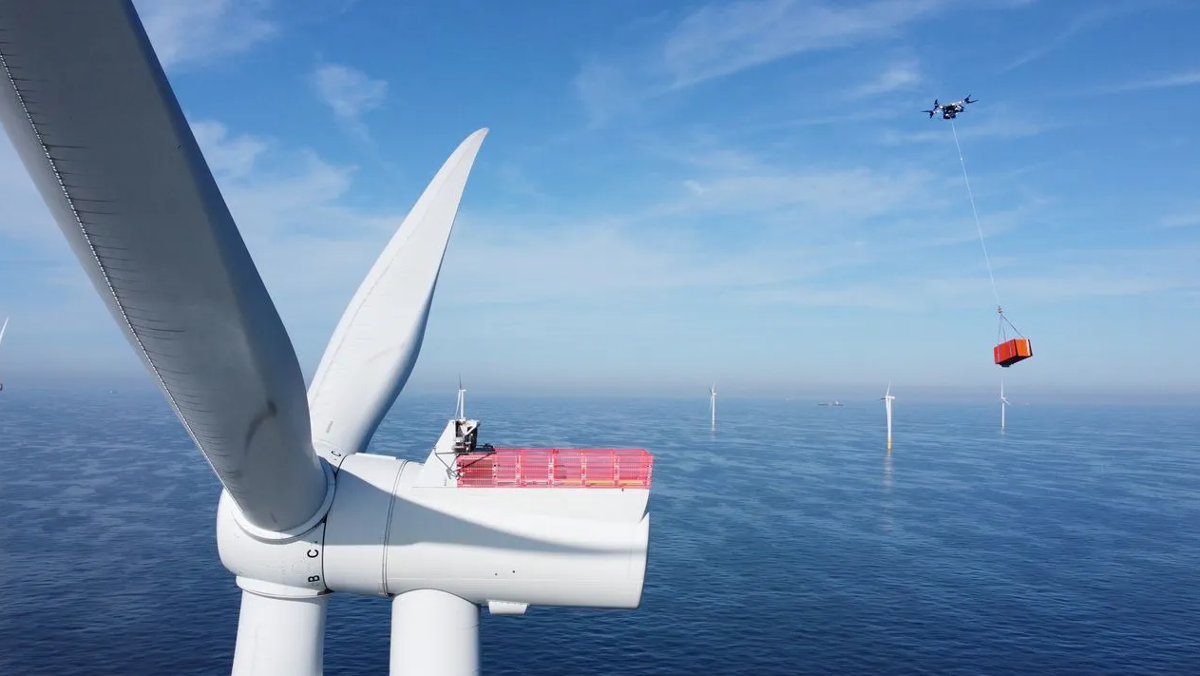
Ørsted, the global leader in offshore wind, is deploying heavy-lift cargo drones (HLCD) for the first time in an operational campaign at the Borssele 1&2 Offshore Wind Farm. This pioneering move marks a significant leap forward in operational efficiency and safety in the offshore wind industry. The heavy lift cargo drone will transport cargo from a vessel to all 94 wind turbines of the Borssele offshore wind farm.
Building on previous trials and expertise using drones in other offshore wind farms, Ørsted is using the 70 kg drones – which have a wingspan of 2.6 metres – to transport cargo of up to 100kg, in an actual operations campaign, after the concept was tested last year at the Hornsea 1 Offshore Wind Farm in the UK.
For this specific campaign, Ørsted has decided to update some critical evacuation and safety equipment in each of the turbines. Normally, a vessel would sail from one wind turbine to the next, using a crane to lift each box containing the equipment onto the transition piece, after which the box would be lifted with the nacelle’s crane to reach the nacelle and then be moved to the top of the turbine. Instead, the drone will simply fly back and forth from an offshore supply vessel directly to the top of the nacelle. The drone flight from the vessel to the turbine takes about four minutes per turbine, while the conventional approach without using drones can take approx. six hours. Taking vessel transport between the turbines and from-and-to shore into account, Ørsted has been able to complete the tasks at Borssele 10-15 times faster than normally.
Rasmus Errboe, Chief Commercial Officer and Deputy-CEO at Ørsted, said: “Ørsted has led offshore wind’s journey from a niche technology to a cost-competitive and large-scale source of renewable power. We’ve done this through some big leaps by for example pioneering new turbine models, but also by continuously moving a lot of new and innovative ideas from the drawing board to real life application. The drones at Borssele 1&2 are a great example of this, as they will improve safety, bring down carbon emissions, and reduce the cost of operating offshore wind farms, which all further improve the commercial fundamentals of offshore wind for investors, governments, and corporations.”
The use of drones to deliver cargo to Borssele 1 & 2 will reduce costs and time as well as improve operational safety and efficiency. Drones mean less work disturbance as wind turbines do not have to be shut down when cargo is delivered. They prevent risk, making it safer for personnel working on the wind farm, and they minimise the need for multiple journeys by ship, reducing carbon emissions in the process.
Ørsted is leading the industry in deploying heavy-lift drones on a larger scale and in an operational campaign. The company is actively seeking partnerships with the best cargo drone operators and services providers to help grow the supply chain.
The new technology is a testimony to Ørsted’s approach to innovation, which has been core to Ørsted’s business from the very beginning, helping to take offshore wind power from a demonstration concept to a large-scale energy technology.
Advances in technology have already brought down the costs of renewable energy, making it cost-competitive with fossil fuels, and Ørsted believes it can continue to harness cutting-edge technology to make green energy more affordable, reliable, efficient, and sustainable across the value chain. Recently, Ørsted has piloted a new technology that further optimises offshore wind monopile installation and it has deployed autonomous vessel for offshore surveying.
Ørsted has in-house R&D capabilities led by a team with deep science and engineering expertise, overseeing 300+ different projects, and the company has partnered with over 50 universities and research institutes, helping to bring the best ideas from the lab to the field.